
The Pistol Range has nine shooting lanes with a retrievable target system. The range is indoors, with the entrance through the Pistol Building. There is a registry on the bar by the door. The doors to the Pistol Building and into the Pistol Range are accessible, with powered openers that actuate with a card scan. Please do not change the settings on the door openers, or pull on them. Let them open on their own.
All range users must print their full name, date, time, and calibers they are shooting in the registry.
All “Magnum” ammunition is disallowed on this range. There are NO EXCEPTIONS. This includes .22 Magnum and .357 Magnum. Use .22 LR or .38 Special instead, or take your firearm to the Rifle Range. 10 MM is disallowed as well.
BB & .177 pellet air rifles and .22 LR rimfire rifles are allowed on this range. The range uses a “snail” type bullet trap backstop designed for ammunition under 600 foot-pounds of force (ft.-lb.f) at the muzzle, or 6000 ft.-lb.f. per square inch impact energy at the backstop. Ammunition that exceeds these limits will damage the backstop. Please see “Allowed and Disallowed Ammunition” below or in the Handbook.
Pistol-caliber rifles are disallowed in the pistol range because their longer barrels lead to increased force, which increases bullet velocity, and therefore greater impact energy against the backstop than an equivalent caliber handgun.
Always be aware of your shooting angle so as to not cause damage to the building or range facilities. If you use a target hanger adjust your angle so you do not shoot anything but the backstop.
Shooting unapproved ammunition and firearms, and/or acting in violation of the fundamental TAB-K rules will result in Club suspension or expulsion.
Range Hours
Monday – Sunday: 8:00 AM to 9:30 PM
Range Location
984 Collins Road
Stoughton WI 53589
Google Maps: https://maps.app.goo.gl/7CoQSuFFT825CH5FA
Range Rules
- Read, understand, and follow all rules in “Fundamental Firearm & Range Rules.” There is no tolerance for violations of the “TAB-K” rules. When your firearm is loaded it must always be pointed downrange, at the backstop.
- All members and guests must sign in to the registry. Members are responsible for all guest behavior, which includes safety. Children must be supervised at all times.
- No continuous rapid fire. No more than five (5) shots in ten (10) seconds are permitted.
- Jacketed and non-jacketed bullets are permitted.
- No long guns or pistol-caliber carbines are permitted except as noted above (BB, .177, .22 LR).
- All shooting must be done from the firing line benches. Never shoot in front of the benches.
- Firearms may only be loaded at the shooting bench.
- Absolutely no drawing from holsters. See Fundamental Firearm & Range Rule 7. Unload it in your car and walk it in, action open.
- Paper or cardboard targets only.
- Targets must be positioned at or beyond the closest red line (7 yards).
- Use target hanger extensions to lower the targets for people sitting while shooting.
- Be sure of your backstop and angle of fire so you do not shoot the ceiling, floor, or walls.
- Use receptacles provided at each range for spent ammunition cases, targets, trash, and duds.Leave the ranges cleaner and better than when you arrived.
Allowed & Disallowed Ammunition
Repeated impact of high energy bullets will damage hardened steel plate backstop material. For this reason, higher energy pistol calibers are excluded from some indoor ranges, like the one at the Club. Discharging firearms in violation of these policies will result in suspension or termination of your membership. Do not shoot ammunition and firearms that are not permitted.
In the Pistol Range, no ammunition is permitted that produces more than 600 foot-pounds of force (ft.-lb.f) at the muzzle, or 6000 ft.-lb.f. per square inch impact energy at the backstop. For more information see “Computing Bullet Impact Energy” below.
Calibers explicitly allowed are BB, .177 pellet, and .22 LR, 38 Special, 380 Auto, 9 MM, 40 S&W, and 45 ACP.
Calibers disallowed include, but are not limited to, all “magnum” rounds including .22 Magnum, .357 Magnum, .44 Magnum, 10 MM, .17 HMR, armor-piercing, tracer, centerfire rifle ammunition, shot shells, shotgun slugs, shot shells with sabots, or pistol-caliber shot shells for handguns. DO NOT SHOOT THESE TYPES OF AMMUNITION. Consider using the Rifle Range for disallowed ammunition and firearms.
You may NOT shoot ANY magnum rounds in the Pistol Range.
You may NOT shoot ANY magnum rounds in the Pistol Range.
If a type of ammunition is not explicitly allowed it needs analysis and approval before using it in the range. Members who hand-load and down-load other calibers may seek approval from the Board of Directors. Please supply caliber and load data so that the bullet impact energy can be computed. If approved, you will also receive further instructions which must be followed when using the range.
Do not shoot ammunition that is not on the approved list or has not been approved in writing by the Board of Directors.
Direct questions to activity leaders and/or the Board, or bring them to a general membership or Board meeting.
The rifle range is often a suitable place to shoot ammunition and firearms that are not compatible with the Pistol Range. See the “Rifle Range” for more information.
Computing Bullet Impact Energy
To make a direct comparison of different calibers and load variations, impact area and cartridge energy are converted into foot pounds of force (ft.-lb.f) per square inch.
Muzzle energy data can be found on the Internet, such as on Wikipedia. In computing energies we use the highest energy value listed, as a worst-case to hedge against variances introduced by bullet shape, core material hardness, and jacket material, which are difficult to calculate.
“Wildcat” and hand loads can be calculated more specifically at shooterscalculator.com if the bullet mass and velocity data are known.

As an example, let’s compute this value for 45 ACP, which has a 0.451” diameter. Using πr2 to calculate the area, we find that the impact area is 0.16 square inch.
To determine the number of bullets in 1 square inch we divide 1 by 0.16, resulting in 6.25.
We know from Internet data that the muzzle energy of a 45 ACP bullet is 587 ft.-lb.f. Plugging these values into the formula above, we get:
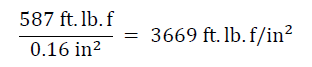
In the Pistol Range, no ammunition is permitted that produces more than 600 foot-pounds of force (ft.-lb.f) at the muzzle, or 6000 ft.-lb.f. per square inch impact energy at the backstop. The force imparted on the pistol range backstop from this 45 ACP round will be 3669 ft.-lb.f/in2, which is below the limit of 6000 ft.-lb.f/in2 and therefore acceptable to fire in the pistol range.
With regard to force at the muzzle, pistol-caliber rifles are disallowed in the pistol range because their longer barrels lead to increased force, which increases bullet velocity, and therefore greater impact energy against the backstop than an equivalent caliber handgun.